




How to Identify Fake Perfume a Complete Expert Guide

Learning how to identify fake perfume is an art that goes far beyond just a quick sniff. It’s about developing a sharp eye for the tiny details—the quality of the box, the feel of the bottle, and even the seller’s reputation. A real fragrance tells a story on your skin, unfolding in layers over hours. Fakes, on the other hand, are usually flat, aggressive, and gone in a flash.
This guide will walk you through the tell-tale signs, turning you into a pro at spotting the imposters.
Key takeaways
- Counterfeit perfumes are produced without safety oversight and have been found to contain industrial chemicals, antifreeze, urine, and bacteria, causing skin irritation, allergic reactions, and respiratory symptoms.
- Packaging red flags include thin or loosely applied cellophane, flimsy paperboard, blurry or misspelled printing such as "parfume" instead of "parfum", and off-shade colors.
- The batch code on the bottom of the box must match the batch code on the bottom of the bottle; a mismatch, a missing code, or a code on a cheap sticker indicates a fake.
- Authentic bottles feel heavy and seamless with flawless glass, a snug metal or dense resin cap, and a collar that sits flush against the neck, while fakes are light, seamed, or bubbled.
By Navid Ara, Fragrancelord. Published 2026-02-02, reviewed 2026-09-27.
The Hidden Dangers of Counterfeit Perfumes
That too-good-to-be-true price on a luxury fragrance can be incredibly tempting, but what’s hiding behind that "bargain" is often pretty grim. The counterfeit perfume industry is a massive chunk of the $1 trillion global trade in fake goods, and it’s not just about getting a subpar scent. It’s a genuine risk.
These fakes are brewed up in unregulated, often filthy, conditions, creating a cocktail of nasty, unlisted chemicals. Spotting a fake isn't just about avoiding a bad purchase; it’s about protecting your health and your hard-earned money. When you buy an authentic fragrance from a trusted source like Fragrance Lord, you're paying for quality, artistry, and safety—three things counterfeiters couldn't care less about.
Health Risks You Can’t Ignore
The most serious threat from a fake perfume is what it does to your skin. To cut costs, counterfeiters use cheap, industrial-grade chemicals and fillers that can cause some serious problems.
- Skin Irritation: We’ve heard countless stories of people experiencing redness, itching, rashes, and even chemical burns from the mystery concoctions in fake fragrances.
- Allergic Reactions: Unlisted allergens can trigger nasty reactions, from hives to much worse, especially if you have sensitive skin.
- Respiratory Issues: Breathing in the harsh vapors from these fakes has been known to cause headaches, dizziness, and can even aggravate asthma.
Lab tests on seized counterfeit perfumes have found a horrifying mix of ingredients, including antifreeze, urine, and dangerous bacteria. Legitimate brands follow strict safety standards, but the fake perfume world is the wild west—there's no oversight, making every bottle a roll of the dice.
The Financial and Quality Cost
Health risks aside, buying a fake perfume is just throwing money away. Sure, the price is low, but the product is worthless. The scent is usually a crude, one-note copy that vanishes within an hour. It completely lacks the beautiful, evolving structure of top, middle, and base notes that makes a genuine fragrance a true experience.
We dive deeper into the craftsmanship of real scents in our guide explaining what makes a perfume expensive.
To really understand the difference and train your nose, a great starting point is a discovery set from a trusted retailer like Fragrance Lord. It’s the perfect way to explore a range of authentic niche and designer fragrances, so you can immediately recognize the superior quality of the real deal.
Your First Clues: The Packaging and Presentation
Long before you ever get a spritz of the scent, the box itself tells a story. Luxury brands pour a tremendous amount of money and effort into the unboxing experience. It’s part of the product. Counterfeiters, on the other hand, are all about volume and speed, so this is where they almost always trip up. If you know what to look for, their mistakes are easy to spot.
Start with the clear plastic wrap. A real fragrance will have thick, taut cellophane wrapped snugly around the box, like it was custom-fit. The folds will be sharp and clean, and the seams will be perfectly sealed. It's a small detail, but it speaks volumes.
On a fake, the cellophane is often a dead giveaway. It's usually thin, crinkly, and loosely applied, sometimes with sloppy, uneven folds or even visible glue smudges. If it looks like it was wrapped by hand in a hurry, that’s a massive red flag.
The Box, The Print, The Feel
Once you’re past the wrap, get a feel for the box itself. Brands like Creed or Tom Ford, both of which you can find at Fragrance Lord, use high-grade, heavy paperboard. It feels substantial in your hand because it's designed to protect a very expensive item.
Fake boxes are a different story. They’re often flimsy, made from cheap material that feels like it could be crushed with a firm grip. Now, look closer at the printing. A legitimate box will have razor-sharp, high-resolution text and logos. Run your fingers over the brand name—sometimes it’s even slightly raised or embossed.
Keep an eye out for these classic counterfeiter blunders:
- Typos and Bad Grammar: It sounds obvious, but a simple mistake like "parfume" instead of "parfum" is an instant sign you're holding a fake.
- Weird Fonts or Logos: The branding should be perfect. If the font looks slightly off, blurry, or stretched, it's a copy.
- Off-Colors: The box color should be rich and consistent. Fakes often have faded, washed-out, or slightly incorrect shades compared to the real deal.
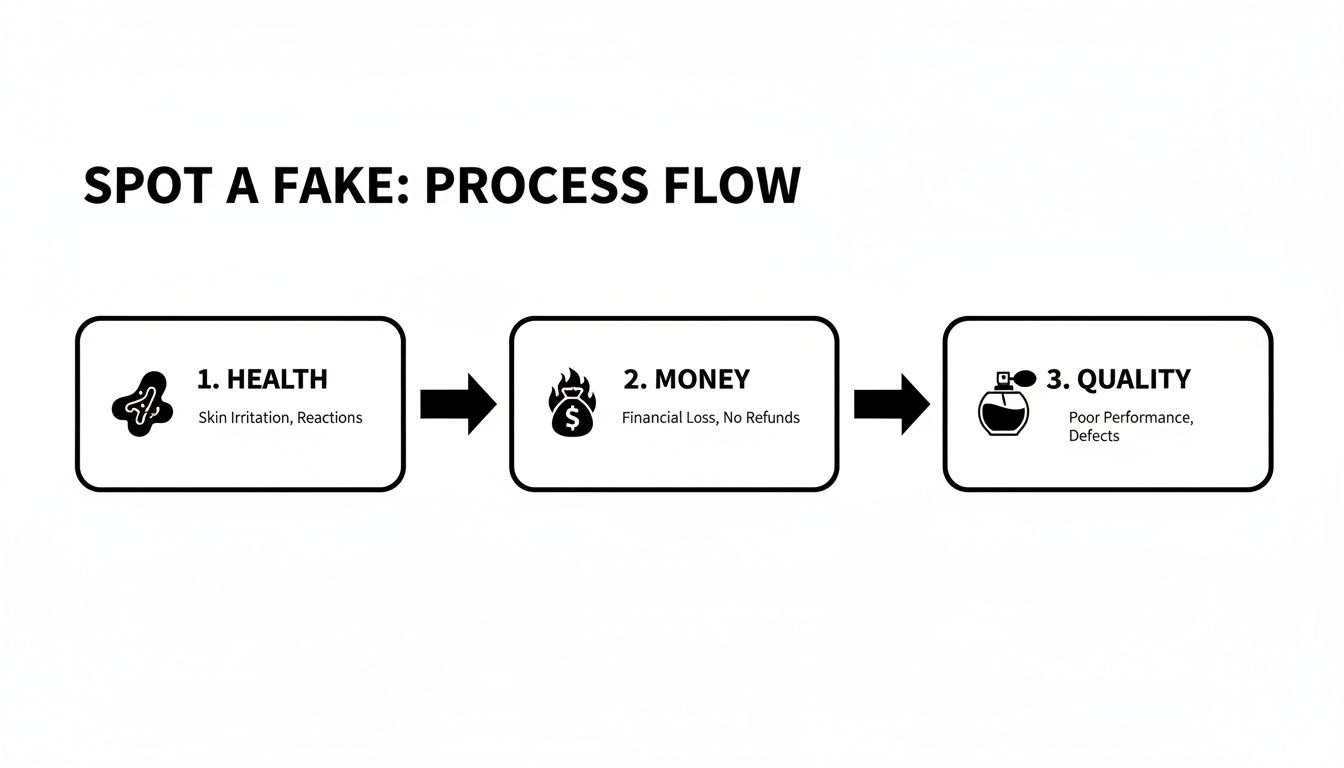
As this shows, it’s not just about getting a subpar product. Counterfeits can pose real health risks and are a complete waste of your money.
Barcodes and Batch Codes: The Final Proof
The last thing to check on the box is the collection of numbers printed on it. The barcode should be cleanly printed and easy to scan. While a scannable barcode isn't a guarantee of authenticity, a blurry or poorly printed one is definitely a warning sign.
The real key here is the batch code. This is an engraved or printed serial number that the manufacturer uses to track a specific production run. On a genuine perfume, you'll find this code on the bottom of the box.
Here’s the most important check: The batch code on the box absolutely must match the batch code on the bottom of the perfume bottle itself. If they don't match, or if one is missing entirely, you've got a fake. It's as simple as that.
Counterfeiters often cut corners here by printing the code on a cheap sticker or by using smudged, low-quality printing. These codes are one of the hardest things for them to replicate perfectly. This lack of detail is a big reason why luxury perfume brands can lose up to 20% of potential revenue to the fake market online.
Once you have an authentic bottle, you'll want to take care of it. Protecting your investment from heat and light is crucial. You can learn the best practices in our guide on how to store perfumes properly. And if you're ever in doubt, pull up the official brand website or a trusted retailer to compare your box with their product photos. It's a quick check that can save you a lot of disappointment.
Get Your Hands on the Bottle: A Tactile Investigation
After giving the box a thorough once-over, it's time to get to the main event: the bottle itself. This is where the story of a fragrance's authenticity really unfolds. You can feel the difference between careful craftsmanship and a cheap knock-off. Luxury brands pour immense resources into creating bottles that are works of art, and counterfeiters just can't match that quality.
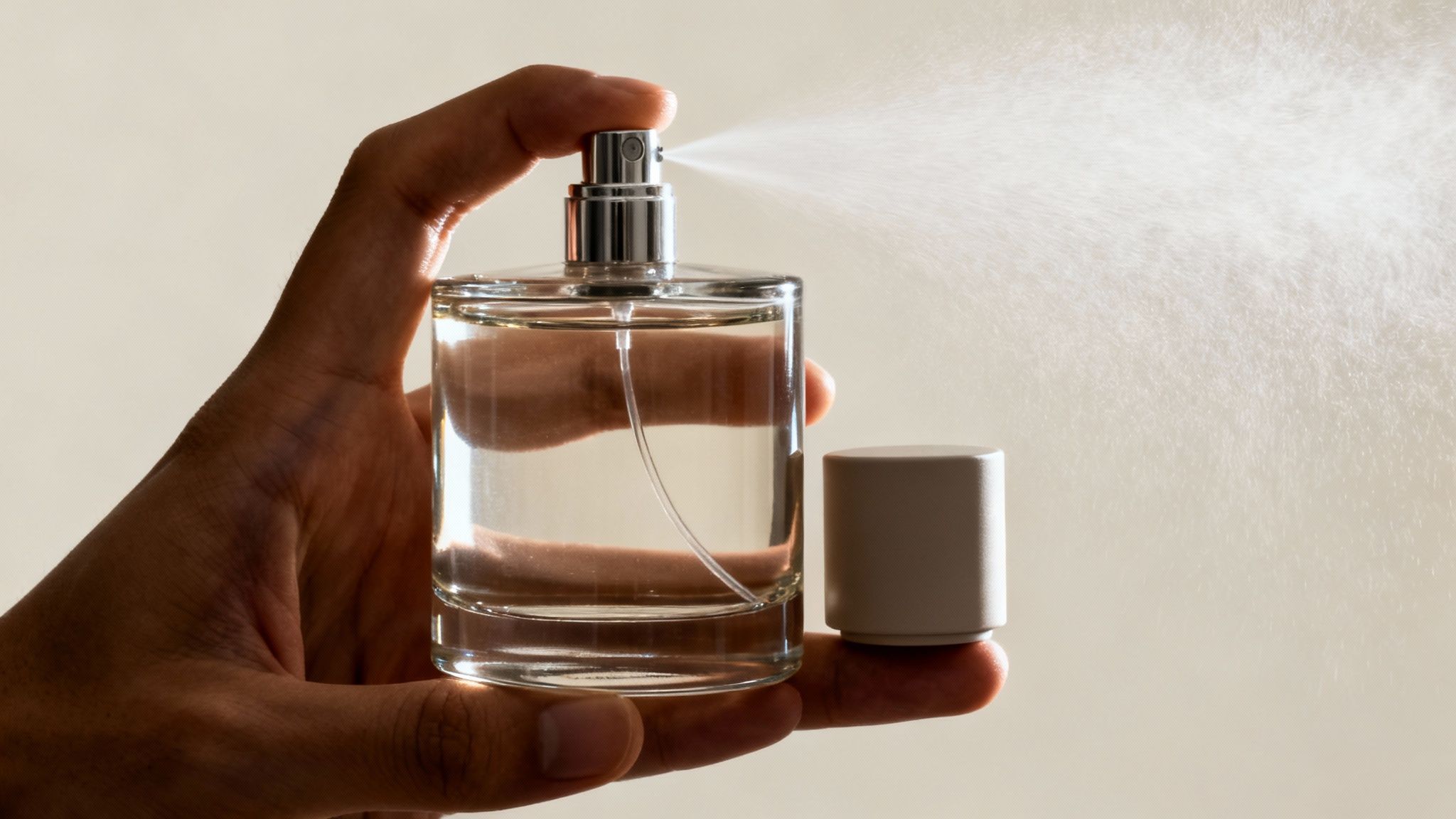
A genuine perfume bottle, especially from a respected house like Parfums de Marly or Xerjoff, has a certain heft to it. It feels substantial in your hand, never hollow or flimsy. These bottles are almost always made from a single piece of high-quality glass, so you shouldn't be able to spot any ugly seams from a mold.
Take a moment to run your fingers over the entire surface. An authentic bottle is perfectly smooth, with no air bubbles, weird bumps, or other flaws in the glass. Counterfeit bottles, on the other hand, often feel lighter and might have those visible seams, little bubbles, or a slightly rough texture—all dead giveaways of a shoddy manufacturing process.
The Cap and Collar Tell-All
The cap is often one of the most obvious signs of a fake. A real cap is engineered perfectly. It clicks into place with a satisfying, snug fit or closes with a smooth magnetic pull. It feels balanced, with a weight that makes sense for the bottle—often made from real metal or a dense, high-grade resin, not some cheap plastic.
This is an area where counterfeiters almost always cut corners. Their caps are usually made of lightweight plastic and just don't fit right. You might find that a fake cap wobbles, won't close flush, or feels comically light. That mismatch in quality is a huge red flag.
Don't forget to check the collar of the sprayer, too. It should sit flush against the bottle's neck without any gaps. On fakes, the collar often looks like a cheap, separate piece that was poorly attached and doesn't blend with the bottle's design.
Authentic perfume bottles are designed to be perfectly symmetrical. Hold the bottle up and look at it from every angle. If anything seems lopsided, crooked, or uneven, you're almost certainly looking at a fake.
A Closer Look at the Sprayer and Dip Tube
The atomizer—the part that does the spraying—is another detail that fakers frequently mess up. A genuine sprayer is designed to release a fine, even mist that beautifully disperses the scent. It should press down smoothly, without sticking or sputtering.
Fake perfumes, however, usually come with clunky plastic sprayers that just don't work well. Keep an eye out for these common problems:
- A Sputtering Mess: The sprayer might shoot out a wet stream of liquid instead of a delicate mist.
- Annoying Leaks: A poorly made atomizer can leak around the collar, making a mess and wasting the fragrance.
- A Sticking Pump: The mechanism might feel stiff, cheap, or get stuck when you press it.
Now, look inside the bottle at the dip tube—the little plastic straw that goes from the sprayer down into the juice. In a real fragrance, this tube is often so clear it's almost invisible, and it's cut to the perfect length to just touch the bottom corner. On fakes, the tube is frequently way too long, causing it to bend awkwardly, or it's made from a thick, cloudy plastic that looks totally out of place.
This tiny detail is a classic sign of a knockoff. Taking care of these delicate parts is important, and if you travel, it's a good idea to invest in some of the best leak-proof perfume containers to keep your collection safe.
The Ultimate Test: Scent and Longevity
After all the visual checks, it’s time for the moment of truth. You can scrutinize a box and a bottle all day, but the real proof is in the perfume itself. Counterfeiters have gotten scarily good at mimicking packaging, but replicating the complex, multi-layered soul of a genuine fragrance? That's where they almost always fall short.
Think of the scent as the ultimate lie detector.
A real perfume is an olfactory journey. It's carefully constructed with what we call the scent pyramid—a structure of three distinct layers of notes that unfold and evolve on your skin over time. Fakes, on the other hand, are almost always flat, linear, and one-dimensional.
What Is a Scent Pyramid, Anyway?
To really spot the difference, you need to know how a genuine fragrance is built. It’s less like a single note and more like a symphony with three distinct movements:
- Top Notes: This is your first impression. It's the bright, attention-grabbing scent you smell right after you spray. These are made of smaller, lighter molecules that evaporate quickly, usually hanging around for the first 5-15 minutes.
- Heart (or Middle) Notes: Once the top notes begin to fade, the heart of the fragrance reveals itself. This is the main character of the perfume, its core personality. These notes typically last for 20-60 minutes.
- Base Notes: Finally, the base notes emerge to anchor the entire experience. Made of large, heavy molecules, they evaporate very slowly, giving the fragrance its depth and staying power. These can linger on the skin for six hours or more.
When you spray a genuine Amouage fragrance, for example, you experience this beautiful transition firsthand. You might get an initial burst of bright spice that slowly melts into a rich floral heart, before finally settling into a warm, sensual base of amber or musk hours later. It tells a story.
The Fake Fragrance Experience
Here’s the counterfeiter's trick: they know most people judge a fragrance in the first few seconds. So, they load up their fakes with an aggressive, recognizable top note that smells kind of like the real thing. It’s an instant, powerful blast designed to fool you right at the counter.
But the illusion doesn't last. Because the fake lacks the complex structure and quality ingredients of a real perfume, that initial scent just... falls apart. Within an hour, sometimes even just a few minutes, it vanishes, often leaving behind a harsh, synthetic, or overwhelmingly alcoholic smell. There's no beautiful evolution—just a cheap imitation that quickly shows its true colors.
A genuine perfume evolves and tells a story on your skin over several hours. A fake perfume shouts one loud sentence and then goes silent, often leaving an unpleasant chemical whisper behind.
Authentic designer and niche perfumes, like the ones we source from Amouage or independent Arabian houses, are built to last. Their layered compositions mean the top notes pop, the heart notes bloom, and the base notes can linger for a solid 6-12 hours, all thanks to high-quality ingredients and fixatives. Fakes are all top note and no substance. They might smell strong at first, but they often crash and reek of cheap alcohol after just an hour or two.
How to Put It to the Test
The only way to truly know is to do a proper wear test. Don't just sniff a paper strip—that won't tell you the whole story. You need to see how it performs on your skin.
The Longevity and Evolution Test:
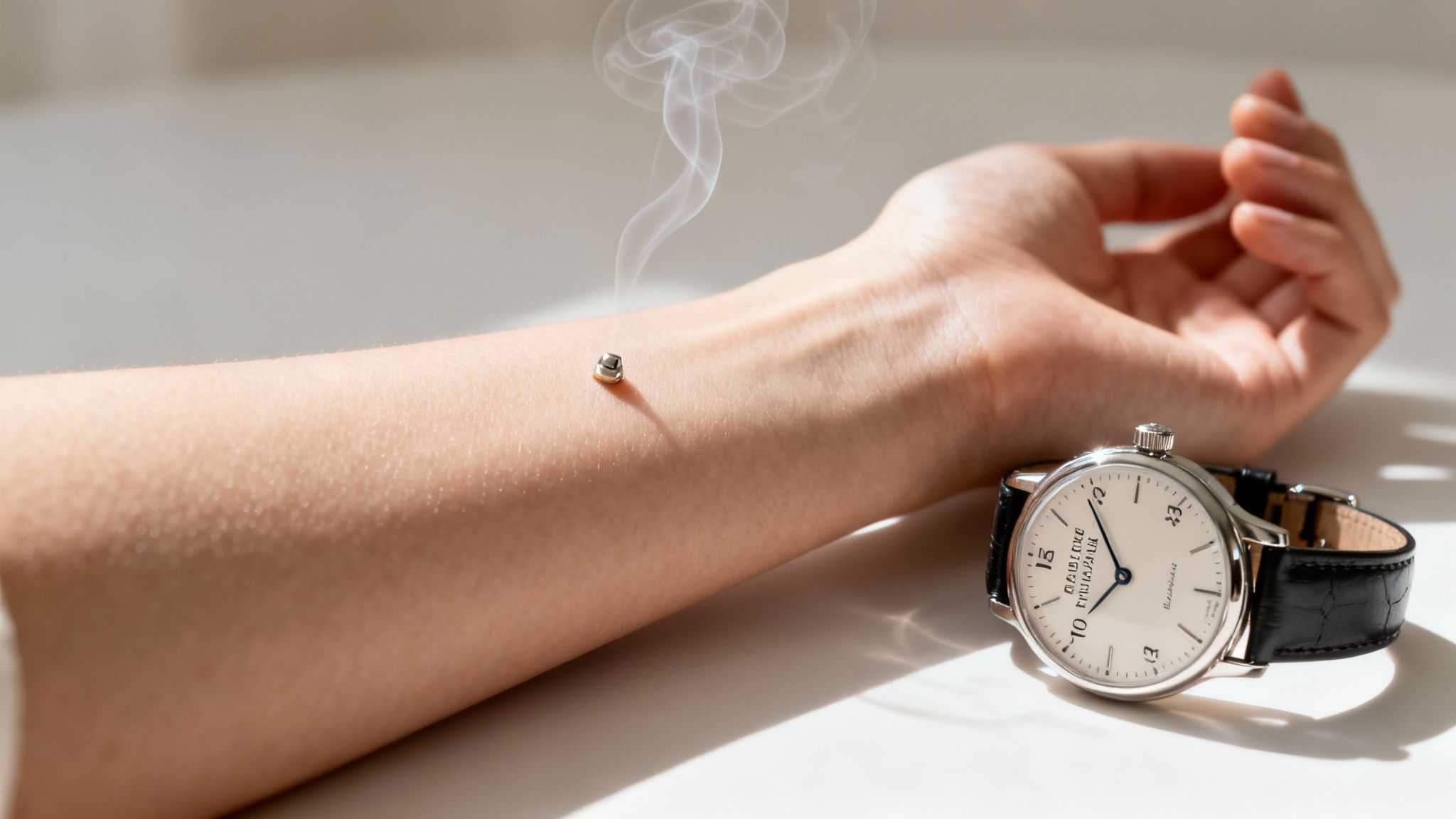
- The First Spray: Apply one spray to your wrist. What's your immediate impression? Does it smell balanced and well-blended, or is it a harsh, chemical-heavy blast?
- The One-Hour Mark: Smell your wrist again after an hour. A genuine fragrance will have settled down, transitioning into its softer heart notes. A fake will likely be fading fast or starting to smell "off."
- The Three-Hour Check-In: By now, a real perfume should be revealing its rich, deep base notes. The scent will be closer to the skin but still complex and present.
- The Final Verdict (Six+ Hours): A high-quality, authentic perfume will still be detectable on your skin hours later, leaving a pleasant, lingering trail. A fake will be a distant memory.
Understanding https://fragrancelord.com/blogs/articles/how-to-make-perfume-last-longer can also give you a better feel for what to expect from a genuine product. If you're really curious, trying to make your own fragrance is an eye-opening experience. Once you understand the artistry and quality that goes into a real perfume, the flaws in a counterfeit become impossible to ignore.
Avoiding Scams: Price and Seller Red Flags
After you’ve done a thorough inspection of the packaging, bottle, and scent, your final line of defense against a fake is to zoom out and look at the marketplace itself. Honestly, your smartest move is often made before you even have the product in hand. It’s all about knowing where to shop and what warning signs to look for.
The oldest rule in the book is still the most important: if a deal seems too good to be true, it absolutely is. A brand-new bottle of a sought-after luxury fragrance being sold for an 80% discount isn't the deal of a lifetime; it's a blaring alarm bell signaling a counterfeit.
Scrutinizing the Seller and Website
The moment you step outside the world of authorized department stores, your guard has to go up. Your safest bet is always to buy from authorized retailers or well-regarded online specialists, where the authenticity of every product is a core promise. This simple choice removes all the guesswork.
When you find yourself on an unfamiliar website, it’s time to play detective. Keep an eye out for these tell-tale signs of a scam:
- Poor Website Quality: Legitimate businesses invest in their online presence. If you see a site littered with typos, awkward grammar, and blurry, stolen product photos, back away slowly.
- Lack of Contact Information: A real company isn't afraid to be contacted. Look for a physical address, a customer service phone number, and a professional email. If the only way to reach them is a generic contact form, that's a huge red flag.
- Vague or Non-existent Policies: Where are the return, shipping, and authenticity guarantee policies? If they're buried, poorly written, or missing entirely, it’s a good sign they have no intention of honoring them.
Decoding Prices and Marketplace Listings
The irresistible lure of a massive discount is the number one tool in a counterfeiter's playbook. You have to know the real market value of a fragrance to spot a fake price.
For instance, fragrances from prestigious houses like Creed or Xerjoff can easily retail for USD 200-500 for a 100ml bottle at a trusted source like Fragrance Lord. That price reflects their use of incredibly rare ouds and precious ambers. Seeing that same bottle listed for 50-70% off on some random website is a clear giveaway. It's a massive problem, too—counterfeits are thought to erode up to 20% of brand revenue in some markets. For more on the science, you can check out this study on the enhanced evaluation of perfume authenticity.
The price of a perfume is a reflection of its quality, artistry, and ingredients. A price that defies logic is almost always a sign that all three of those pillars are missing.
On big marketplaces like eBay or Amazon, the seller's reputation is everything. Don't just look at the overall star rating; you need to dig into the actual reviews.
Here’s what a trustworthy seller’s profile usually looks like:
- A Long History: A seller with thousands of transactions spanning several years is far more likely to be legitimate than a brand-new account that just popped up.
- Consistent Positive Feedback: Scan recent reviews. Do they specifically mention the perfume's authenticity? Do they talk about fast shipping and good customer service?
- Transparent Listings: The seller should be using their own photos of the actual item, not just generic stock images. The description should be clear and detailed.
Ultimately, keeping fakes out of your collection starts with being smart about where you shop. Sticking to vetted and authorized sources is the only way to guarantee you get the genuine, high-quality experience you're paying for. For more on this, have a look at our guide on where to buy authentic perfume online. Being proactive is the single most effective way to protect yourself.
Got a tricky situation? Let's clear a few things up.
Even with the best checklist, you're bound to run into some gray areas. The world of fragrances is full of nuances, and counterfeiters are always trying to find new ways to trip you up.
So, let's tackle a few of the most common questions that pop up when you're on the hunt for a genuine scent. Think of this as the troubleshooting section for when things aren't quite adding up.
What Should I Do If I Already Bought a Fake Perfume?
That sinking feeling when you realize you've been duped is the worst. But don't just toss it in frustration—you have options. First and most importantly, stop using it immediately. Fake perfumes are made in unregulated labs, and you have no idea what's really in that bottle. The risk of skin rashes, allergic reactions, or worse just isn't worth it.
Once you've set it aside, it's time to get your money back. Your game plan depends on how you paid:
- Bought from a marketplace? If you got it from a site like eBay or Amazon, start by messaging the seller directly. At the same time, open a case through the platform's buyer protection program. These programs are built for this exact scenario. Be sure to upload clear photos showing the shoddy packaging, mismatched batch codes, or anything else that proves it's a fake.
- Paid with a credit card? You've got a great ally here: the chargeback. Call your credit card company and tell them you received counterfeit goods. They'll walk you through the dispute process.
In both cases, your camera is your best friend. Document everything with clear, well-lit photos. The more evidence you have, the smoother the process will be.
Can the Same Perfume Have Different Packaging?
Absolutely, and this is a common point of confusion that counterfeiters love to take advantage of. Brands frequently update their packaging over the years. A bottle of Dior Sauvage from 2015 might look slightly different from one produced in 2023.
It's not just the box, either. The fragrance formula itself can change over time in a process called reformulation. This can result in slight scent variations and, of course, new batch codes. So, don't panic if your new bottle isn't an identical twin to an old one. The real tell is the quality. A legitimate redesign will still feature crisp printing, sturdy materials, and a perfectly fitting cap. A fake will cut corners.
Quick tip: Don't treat a batch code checker website as the ultimate authority. These are unofficial databases and are often incomplete. If a code doesn't show up, it doesn't automatically mean you have a fake. The most critical test is ensuring the code on the box matches the one etched on the bottle.
Is It Safe to Buy Tester or Unboxed Perfumes?
Snagging a "tester" bottle can be a great way to save money on an authentic fragrance, but it comes with a huge risk. You have to be 100% certain you're buying from a reputable, trustworthy source.
Official testers are the real deal—they're the same bottles sent to department stores for customers to try. They usually arrive in a plain box (or no box at all) and are often marked "Tester - Not for Sale." Because they lack the fancy retail packaging, they're sold at a discount.
The problem? This is a goldmine for counterfeiters. Selling an unboxed product lets them skip the effort of faking a high-quality box. Unless you have unwavering trust in the seller's reputation and history, buying testers is a gamble. If the price looks too good to be true, even for a tester, it almost certainly is.
The easiest way to sidestep all this guesswork is to buy from a source you can trust from the very beginning. At Fragrance Lord, we guarantee that every single bottle we sell is authentic—from niche houses like Xerjoff and Amouage to the biggest designer names. You can explore our curated collections and discovery sets with complete peace of mind, knowing you're getting the genuine article. Find your next signature scent with us today at https://fragrancelord.com.