




What Are Base Notes in Perfume and Why They Matter

Base notes are the very soul of a perfume. They are the deep, foundational scents that ground a fragrance, anchoring it to your skin and lingering long after the initial burst has faded. Think of them as the final act of a fragrance story—the rich, memorable scent that stays with you for hours.
Key takeaways
- Base notes consist of the largest, heaviest molecules in a formula, so they evaporate slowest and typically emerge about 30–60 minutes after application, lasting roughly 4–8 hours.
- In the fragrance pyramid, top notes fade within 5–15 minutes and heart notes carry the scent for a few hours, while base notes supply the depth and lingering dry-down.
- Base materials often make up 32% to 55% of a fragrance formula and act as fixatives, slowing the evaporation of lighter top and heart notes to boost overall longevity and sillage.
- Common base ingredients include woods such as sandalwood and cedar, resins like amber, vanilla, oud, and musks—with sandalwood and musk appearing in over 40% of commercial scents.
By Navid Ara, Fragrancelord. Published 2026-02-12, reviewed 2026-09-27.
The Foundation of a Fragrance
Ever sprayed a perfume you loved in the morning, only to have it disappear by lunch? Or maybe you've noticed a scent morph throughout the day, starting off bright and zesty but settling into something warm and musky. That's not magic—it's the art of perfume structure, and the secret is all in the base notes.
Imagine a perfume is like a piece of music. The top notes are the bright, attention-grabbing opening flourish. The heart notes are the central melody that defines the theme. But the base notes? They are the deep, resonant bassline that gives the whole composition its depth, structure, and lasting power. Without them, a fragrance would feel shallow and would vanish in a flash.
Why Base Notes Have Staying Power
The secret to their longevity lies in chemistry. Base notes are made of the largest, heaviest molecules in a perfume's formula. Because of their sheer size, they evaporate much more slowly than their lighter counterparts.
This slow-burn evaporation is why you don’t really smell the base notes right away. They patiently wait their turn, revealing themselves only after the more flighty top and heart notes have danced away. This final, lingering stage is what we call the "dry-down," and it's where the true character of a fragrance comes to life. It’s the warm, intimate scent that clings to a favorite scarf or the subtle trail you leave in a room.
The dry-down is the perfumer's true intention. It’s the final word, the core message of the fragrance that is designed to endure and create a lasting impression.
Learning to appreciate this slow reveal is the key to picking a fragrance you'll love from the first spritz to the last whisper. To really understand how all the parts work together, you can dive deeper into the difference between top, heart, and base notes in our full guide. Of course, the best way to learn is by experiencing it yourself. Testing a scent on your skin is the only way to know how its base will unfold, and exploring the discovery sets at Fragrance Lord is the perfect way to watch that evolution happen.
Understanding the Fragrance Pyramid
Every perfume tells a story, and like any good story, it has a beginning, a middle, and an end. This narrative structure is what we call the fragrance pyramid. Instead of a single, flat scent, a well-made perfume is designed to unfold in layers, revealing different facets of its character over time.
Think of it as a piece of music. You have the bright, attention-grabbing opening notes—a flash of strings or a high-pitched woodwind. Then comes the main melody, the heart of the song that carries the emotional weight. Finally, you have the deep, resonant bassline that anchors the entire composition and lingers long after the melody fades. That's the role of the base notes.
The Three Acts of a Scent
The fragrance pyramid is built on a simple principle of chemistry: different scent molecules evaporate at different speeds. This carefully orchestrated evaporation is what creates the scent's journey from the first spray to its final, lingering whisper.
-
Top Notes: This is your first impression. Made of the smallest, most volatile molecules, they hit your nose immediately with a burst of energy but vanish just as quickly, usually within 5 to 15 minutes. These are often zesty citruses, fresh herbs, or airy aldehydes.
-
Heart Notes: As the top notes recede, the heart of the fragrance makes its entrance. These notes are the true core of the scent, defining its personality. Think lush florals like jasmine and rose, or warm spices like cinnamon and nutmeg. They form the bulk of the experience and can stick around for a few hours.
-
Base Notes: And now for the grand finale. Base notes are the foundation, composed of the largest, heaviest molecules that are the slowest to evaporate. They anchor the entire fragrance, giving it depth, richness, and that unforgettable trail that stays on your skin for hours.
This pyramid structure is the secret to a dynamic, evolving fragrance.
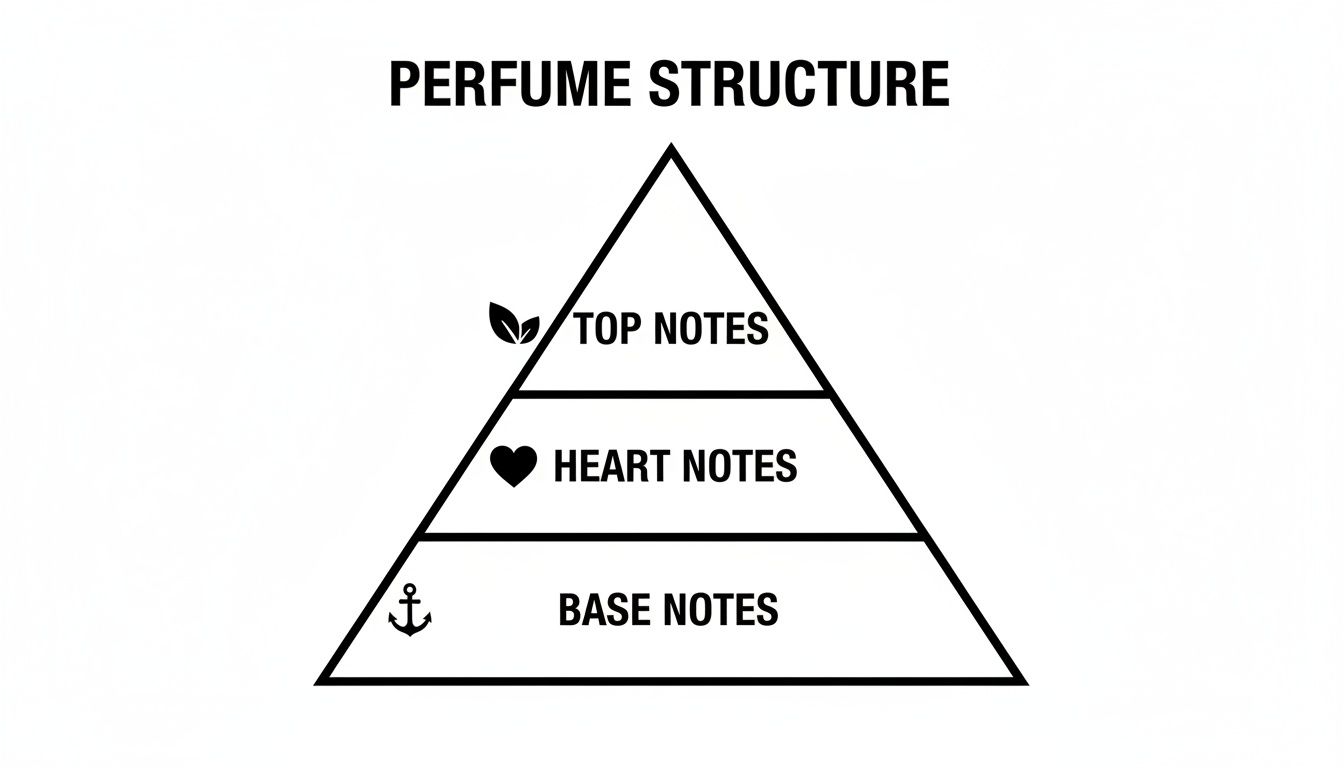
As you can see, the base notes are the bedrock of the entire scent, supporting the more fleeting notes above them.
To break it down even further, here's a quick look at how these layers compare.
The Three Layers of a Perfume
| Note Layer | Appearance Time | Longevity | Primary Role | Common Ingredients |
|---|---|---|---|---|
| Top | 0–15 minutes | Shortest | Creates the initial impression and hooks you in. | Citrus (Lemon, Bergamot), Light Herbs (Mint), Aldehydes |
| Heart | 15–60 minutes | Moderate | Forms the main character and body of the scent. | Florals (Rose, Jasmine), Spices (Cinnamon), Green Notes |
| Base | After 60 minutes | Longest | Provides depth, longevity, and a lasting memory. | Woods (Sandalwood, Cedar), Resins (Amber), Musks |
This table really highlights how each part of the pyramid plays a distinct but essential role in crafting the final experience.
Why Each Layer Matters
Every layer has a job to do, and the base notes carry a particularly heavy load. They aren't just what’s left at the end of the day; they are a huge part of the formula from the start. In fact, industry insiders often formulate fragrances with 32% to 55% base note materials to ensure the scent has a solid backbone and serious staying power. It's this high concentration of rich, heavy molecules that allows a fragrance to last for four hours or even longer.
A perfume without a solid base is like a story without an ending. It’s the final, lingering scent that creates a lasting memory and gives the fragrance its signature depth.
Getting a feel for this progression is the key to truly understanding perfume. To dig deeper into this, check out our guide on how perfume notes develop over time.
How Base Notes Define a Perfume's Staying Power
Have you ever wondered why one fragrance lasts all day, commanding attention for hours, while another vanishes almost as soon as you spray it? The secret isn't some kind of magic. It all comes down to the science of base notes.
These foundational ingredients are the heavy lifters in any perfume, single-handedly determining two of its most important qualities: longevity (how long it lasts) and sillage (the scent trail you leave behind).
It's all about molecular weight. Base note molecules are large, dense, and heavy, which means they evaporate incredibly slowly. This slow-burn effect is what gives them the power to cling to your skin for hours, creating that deep, memorable finish that defines a great perfume.
The Anchor of a Fragrance
Think of base notes as the anchor of the entire scent. They act as a natural fixative, holding down not just their own aroma but also the much lighter, more volatile top and heart notes.
By slowing down the evaporation of the entire blend, they help the bright, fleeting top notes and the character-filled heart notes stick around longer. This creates a much more seamless and long-lasting experience, allowing the fragrance to tell its full story on your skin.
It’s pretty simple, really. A perfume built on a rich foundation of amber, oud, vanilla, or sandalwood will naturally have more staying power than a light, citrus-forward scent with a barely-there base. These ingredients provide the depth and structure a fragrance needs to perform for hours on end.
Base notes are the reason a scent can evolve from a bright introduction to a deep, intimate whisper that lingers for hours. They are the true measure of a perfume's endurance and character.
These foundational elements, sometimes called 'dry-down notes,' are the earthy, sensual finishers in a perfume's journey. They typically make their grand entrance after about 30-60 minutes and can easily last for 4-8+ hours in a well-made fragrance. In fact, ingredients like sandalwood and musk are found in over 40% of all commercial scents precisely because they provide that crucial, long-lasting backbone.
Finding a Scent That Goes the Distance
If you’re looking for a fragrance with serious longevity and a captivating trail, the key is to seek out compositions that are driven by strong base notes. To get a better handle on these concepts, check out our guide on the difference between sillage and longevity in perfumes.
For those ready to experience this power firsthand, the collections at Fragrance Lord from houses like Amouage and Xerjoff are famous for their masterful use of rich, potent base notes. These are fragrances built to perform, making them a perfect starting point for anyone who wants a scent that truly lasts.
A Guide to Common Base Notes by Scent Family
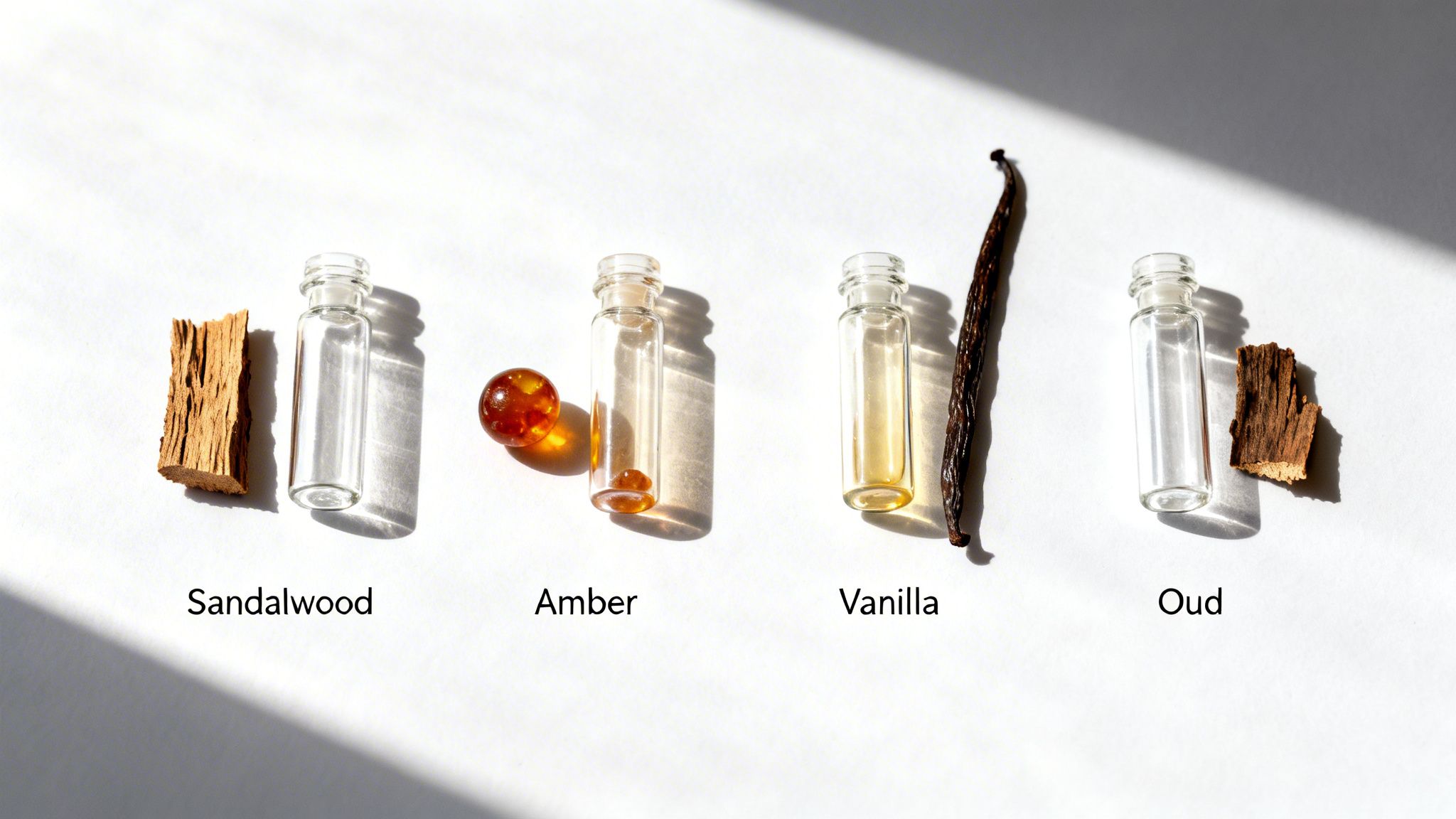
Now that we've covered how base notes anchor a fragrance, let's start building your scent vocabulary. The real secret to finding a perfume you'll love for years is learning to identify the specific aromas that speak to you. Base notes are incredibly diverse, pulling from various fragrance families to create a whole spectrum of moods—from earthy and grounding to warm and decadent.
By exploring these categories, you can begin to pinpoint what it is about a perfume that keeps you captivated, long after that initial spritz has faded.
The Woody Family
Woody notes are the absolute backbone of perfumery. They provide structure, elegance, and a solid, grounding presence. Think of them as the foundation of the fragrance pyramid, engineered with heavy molecules that evaporate slowly to linger for hours. Their personalities range from creamy and smooth to dry and smoky, each one bringing something different to the table.
It's no surprise that woody notes are so popular. A 2022 report found them in 45% of top-selling men's fragrances. In more concentrated Arabian collections, like the oud-focused lines from Xerjoff, base notes can make up over 50% of the formula, delivering that incredible 8 to 12-hour performance.
- Sandalwood: Forget raw, splintery wood. True sandalwood is creamy, milky, and buttery smooth. It’s less of a scent and more of a feeling—like a rich, comforting embrace. For a perfect example, look no further than Creed Original Santal, where sandalwood creates a warm, spicy, and undeniably regal foundation.
- Cedarwood: This one is sharper, drier, and more aromatic. It has that distinct smell of a freshly sharpened pencil or a walk through a pine forest on a cool day. Cedarwood adds a clean, structured, and slightly spicy edge.
- Oud (Agarwood): Deep, complex, and powerful. Oud is a fascinating resinous wood that can smell medicinal, animalic, smoky, and leathery all at once. It’s a true statement note. To experience its unforgettable character, explore the offerings from Xerjoff right here at Fragrance Lord.
- Vetiver: While technically a grass root, its profile is all wood. It's earthy, grassy, and sometimes smoky, adding a sophisticated and rugged feel to any fragrance.
The Amber and Resin Family
Resinous notes, derived from the sap of trees, carry an almost ancient, mystical quality. Perfumers prize them for their warmth, depth, and ability to give a fragrance's dry-down a glowing, golden aura.
Ambers and resins are the golden hour of a perfume. They create a warm, enveloping glow that feels both luxurious and profoundly comforting, often defining the entire mood of the final dry-down.
Amber itself isn't a single ingredient but rather an "accord"—a masterful blend of notes like labdanum, benzoin, and vanilla. Together, they create a signature scent that is warm, sweet, and slightly powdery. A true masterpiece in this category is Maison Francis Kurkdjian Grand Soir, a fragrance that is pure, unadulterated amber warmth in a bottle.
The Gourmand Family
Gourmand notes are simple: they smell deliciously edible. They bring a comforting, cozy, and sometimes playful sweetness to a perfume's foundation. This is what makes the final hours of a scent feel so familiar and utterly irresistible.
- Vanilla: The undisputed queen of gourmand bases. Vanilla can be creamy and sweet like cake batter, or it can be smoky and boozy like a fine extract. For an iconic take, Tom Ford Tobacco Vanille blends rich, opulent vanilla with spicy tobacco for a truly unforgettable finish.
- Tonka Bean: A fascinatingly complex note. It smells like a mix of vanilla, cherry, almond, and cinnamon all rolled into one. It’s warmer and spicier than straight vanilla, adding a sophisticated, almost marzipan-like sweetness.
- Cacao: Imagine the scent of dark, unsweetened chocolate. Cacao provides a rich, slightly bitter, and dusty warmth that adds incredible depth without being overly sugary.
Learning to tell these notes apart is a rewarding journey. To understand how these families fit into the bigger picture of scent classification, check out our complete guide to fragrance families.
How To Test Perfumes To Truly Experience The Dry-Down
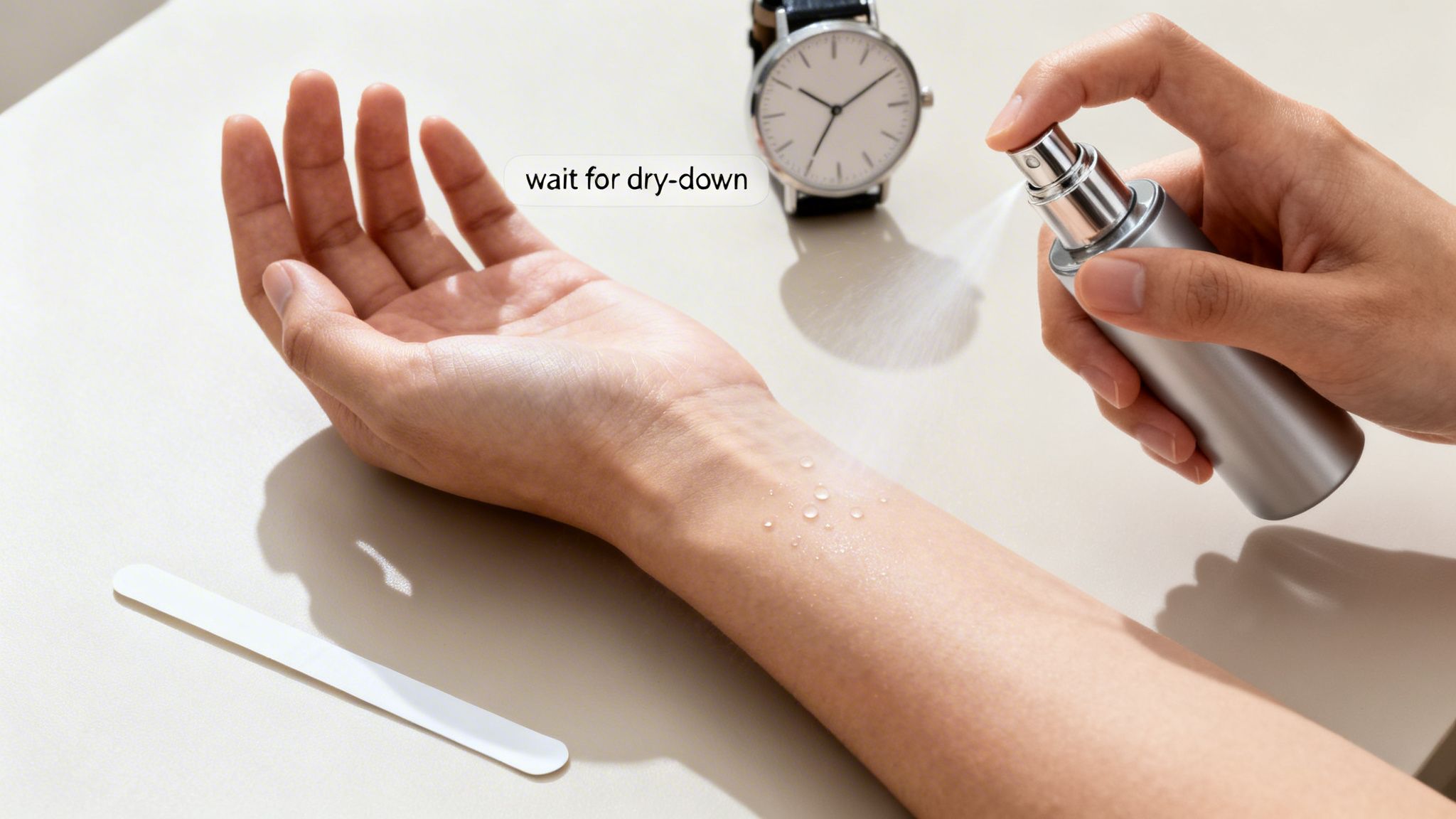
We’ve all done it—fallen head over heels for a perfume at first spray. It’s easy to get swept away by that bright, dazzling opening. But that first impression is just the introduction, not the whole story.
The real heart and soul of a fragrance, the part you’ll be living with for hours, only emerges during the dry-down. This is where the base notes come out to play, and to understand them, you have to get the perfume on your skin. A paper blotter just can't replicate the unique magic that happens when a scent mingles with your personal chemistry.
The Art of Patient Testing
So, how do you properly test a fragrance? The secret is simple: patience. You can't rush this process. You need to give those deep, complex base notes the time they need to surface and settle into their final form.
Here’s a straightforward guide to testing any new scent the right way:
- Spray It on Your Skin: Forget the paper strip. Apply the fragrance directly to your pulse points, like the inside of your wrists or the sides of your neck. The natural warmth of these areas helps the scent molecules to warm up and develop as the perfumer intended.
- Don't Rub Your Wrists Together: It’s a common habit, but rubbing creates friction that can literally crush the delicate fragrance molecules. This disrupts the carefully constructed pyramid, muddling the notes and rushing the experience. Just let it air dry naturally.
- Wait for the Magic: This is the most important part. Give the perfume at least an hour, though several hours is even better. You need to let it journey past the initial top notes and the fleeting heart. Pay close attention to how it evolves on your skin and which aromas linger the longest.
A perfume's base notes are its final, honest statement. Testing a scent on your skin for several hours is the only way to hear what it truly has to say about itself—and about you.
The Smartest Way to Sample
This patient approach is exactly why trying samples is the single best thing you can do when exploring new fragrances. Buying a full bottle after a five-minute spritz in a store is a huge gamble. The most intelligent and budget-friendly way to find a scent you'll truly love is to start with travel-size decants or curated discovery sets.
Here at Fragrance Lord, we have a huge selection of samples from top-tier luxury and niche brands. This gives you the freedom to really live with a scent for a day, a week, or even longer. You get to experience its full dry-down, see how its base notes perform, and ensure it works beautifully with your skin chemistry. It's the ultimate "try before you buy," making sure every full bottle you purchase is a perfect match.
For more in-depth advice, check out our complete guide on how to test a perfume before buying.
Your Questions on Perfume Base Notes, Answered
By now, you've seen just how crucial base notes are to the soul of a fragrance. They're the grand finale, the lasting memory. But as with any art form, the details can bring up a few questions. Let's dig into some of the most common ones.
Can a Perfume Be Made Entirely of Base Notes?
Technically, yes, but it wouldn't be very exciting. A fragrance built only from heavy base notes would feel dense, flat, and might even come across as a bit suffocating. It would miss the sparkle of a bright opening and the personality that unfolds as the heart notes emerge.
The real artistry in perfume is how the top, middle, and base notes dance with each other. It’s that journey from the initial spritz to the final hours that makes a scent compelling. Even single-note-focused "solinote" scents usually have a few other ingredients tucked in to give them a little lift and keep them from falling flat.
Why Can't I Smell the Base Notes Right Away?
It all comes down to chemistry. Base notes are made of big, heavy molecules that don't like to evaporate quickly. Think of them as the slow-burn elements of the fragrance. When you first spray a perfume, the tiny, flighty top-note molecules are the first to hit your nose.
Only after the top notes have vanished and the heart notes have bloomed do the base notes finally get their turn in the spotlight. This slow reveal is what we call the "dry-down," and it’s where the true character of the perfume settles in for the long haul.
Do Base Notes Really Smell Different on Everyone?
They absolutely do. This is where fragrance gets personal. Base notes are the part of the perfume that sticks around the longest, meaning they have the most time to mingle with your unique skin chemistry—your body heat, your natural oils, even the pH of your skin.
This is why a perfume can smell divine on your friend but just "meh" on you. A creamy sandalwood on one person might turn sharp and dry on another. A sweet, gourmand vanilla could become richer and almost boozy, or it might quiet down completely.
The only way to truly know how a perfume will behave is to test it on your own skin. This is why trying a sample first isn't just a good idea; it's essential.
How Can I Make My Perfume Last Longer?
Getting more life out of your fragrance is all about giving those base notes a good foundation to cling to. The single best thing you can do is apply your scent to well-moisturized skin. Think of dry skin as a sieve and moisturized skin as a sponge.
For a scent that truly goes the distance, try these simple tricks:
- Hydrate First: Slather on an unscented lotion or body oil right after you shower. This creates the perfect canvas for your fragrance.
- Hit the Pulse Points: Spray on warm spots like your wrists, the crook of your elbows, and the back of your neck. Your body heat will gently radiate the scent all day.
- Go for a Higher Concentration: An Eau de Parfum (EDP) or an Extrait de Parfum has a much higher percentage of fragrance oils—and a stronger base—than an Eau de Toilette (EDT). They are built to last.
Following these tips helps ensure those rich, complex base notes stick around to be enjoyed for hours on end.
Ready to experience how the world's most captivating base notes play out on your skin? At Fragrance Lord, we believe in trying before buying. Explore our huge collection of authentic niche and designer fragrance samples to find the scent that tells your story—from the first spritz to its final, unforgettable whisper. Start your fragrance journey today at Fragrance Lord.