




Fragrance Layering Tips The Art of Creating Your Signature Scent

Think of fragrance layering as your own personal form of scent alchemy. It’s not just about spraying on more perfume; it's about creatively combining different fragrances to design a signature scent that’s completely, uniquely you.
Key takeaways
- Fragrance layering means applying two or more scents in sequence to build a custom blend, and it can extend wear time by anchoring lighter, faster-evaporating notes.
- Apply the heaviest concentration first: Parfum (20-30% oil) as the base, Eau de Parfum (15-20%) in the middle, and Eau de Toilette (5-15%) on top.
- The four main fragrance families are Floral, Oriental (Amber), Woody, and Fresh, with Floral pairing well with Fresh, Woody, and Amber scents.
- Spray scents on separate pulse points rather than the same spot, and apply to clean, moisturized skin after a shower so the oils have something to cling to.
By Navid Ara, Fragrancelord. Published 2026-01-06, reviewed 2026-09-27.
Discovering Your Scent Alchemy
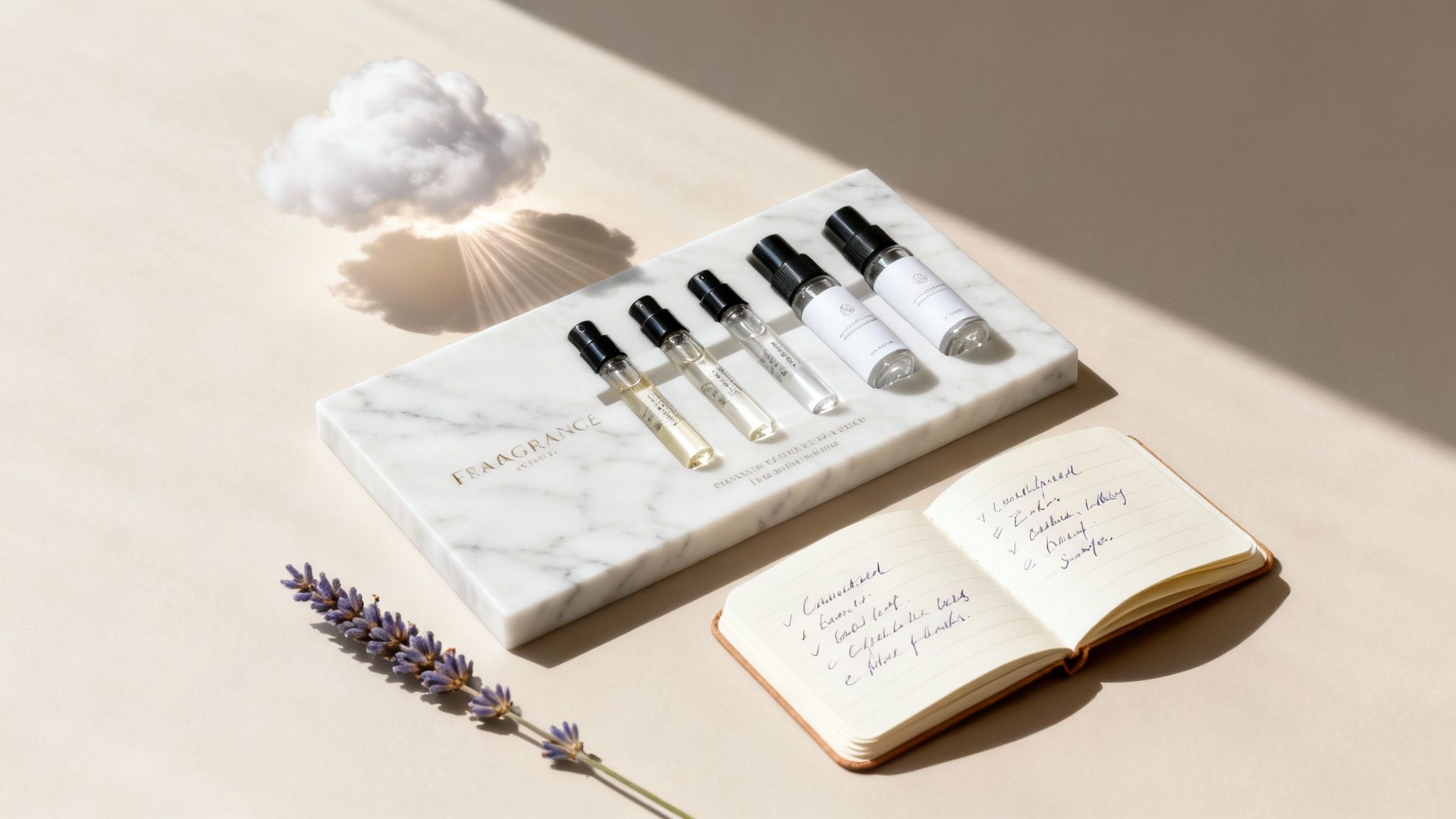
Forget the idea of being tied to a single, static perfume. When you start layering, you’re not just wearing a fragrance—you're building a scent wardrobe. You're telling a story. And don't worry about "getting it wrong" or overdoing it. The whole point is to strategically combine notes to craft something new.
This approach gives you a perfumer’s palette to play with every single day. You can tweak your scent to match your mood, the season, or a specific occasion. It’s all about having the confidence to experiment.
So, Why Bother Layering?
One of the biggest wins is longevity. Hands down. Layering can help anchor lighter, more fleeting notes, making your scent last hours longer. It also breathes new life into perfumes you already own, adding surprising depth and complexity. That simple floral you love? Add a touch of amber, and it suddenly becomes warmer and more mysterious. That sharp citrus? A creamy vanilla base can soften its edges beautifully.
This isn't just a niche trick anymore; it's a full-blown movement. In fact, a recent survey showed that 29% of Gen Z actively layer their scents. With the global perfume market projected to hit US$83.5 billion by 2032, this desire for personalized fragrance experiences is a huge part of what's driving that growth.
The true magic of layering is that you become the perfumer. You're not just choosing a scent; you are composing one. This makes your fragrance an invisible, yet unforgettable, part of your identity.
Getting Started on Your Journey
The best way to dip your toes in is to play around without committing to a full bottle. This is where our curated discovery sets and travel sprays from Fragrance Lord are your best friends. They let you experiment with different combinations from top brands like Creed, Tom Ford, and Parfums de Marly to see what really works with your personal skin chemistry before you invest.
A great place to start is by locking down a solid base scent. Our guide on how to find your signature scent can walk you through finding that perfect foundation for all your layering experiments.
Getting To Know Your Fragrance Building Blocks
Before you start mixing and matching, you have to know what you’re working with. It's a lot like cooking—you wouldn't throw spices into a pot without knowing what they taste like first. Learning the language of fragrance is the first step to creating a scent that's uniquely yours, moving beyond guesswork into true artistry.
Every perfume is made up of a few core elements that define its personality, its performance, and, most importantly, how it plays with others.
The Foundation: Fragrance Families
Perfumes are typically grouped into broad categories called fragrance families. Scents within the same family share common traits, making this the easiest roadmap for finding great pairings. While the world of fragrance is vast, most perfumes fall into four main families:
- Floral: Think sweet, romantic, and classic. These are built around notes from flowers like rose, jasmine, and lily.
- Oriental (Amber): Warm, spicy, and often a little mysterious. They feature rich notes like vanilla, myrrh, incense, and amber.
- Woody: Earthy, warm, and grounding. These fragrances are built on notes like sandalwood, cedarwood, and vetiver.
- Fresh: Bright, clean, and energizing. This family covers everything from citrus and green notes to aquatic scents like bergamot, fresh-cut grass, and sea salt.
Once you know these groups, you can start predicting which scents will vibe together. For example, pairing a light Floral with a deep, grounding Woody scent often creates an absolutely beautiful contrast. To really get a handle on this, it's worth exploring the fundamentals of essential oils and aromatherapy to sharpen your scent intuition.
Below is a simplified guide to get you started on pairing different scent families for harmonious results.
A Quick Guide To Pairing Fragrance Families
| Fragrance Family | Characteristics | Pairs Well With |
|---|---|---|
| Floral | Romantic, powdery, fresh | Fresh, Woody, Oriental (Amber) |
| Oriental (Amber) | Warm, spicy, opulent | Floral, Woody |
| Woody | Earthy, smoky, warm | Floral, Fresh, Oriental (Amber) |
| Fresh | Zesty, aquatic, green | Floral, Woody |
This table is just a starting point, of course. The best part of layering is the experimentation, so don't be afraid to break the "rules" once you know them.
Unpacking The Scent Pyramid
Beyond families, every perfume has a structure—often called the fragrance pyramid. This is the journey a scent takes on your skin, made up of top, middle (or heart), and base notes that reveal themselves over time. Understanding this is probably one of the most practical tips for layering you'll ever get.
Think of it this way: the top notes are the first impression, the heart is the main story, and the base notes are the lingering memory. When you layer, you're essentially weaving two stories together.
We have a whole guide that breaks down the difference between top, heart, and base notes. It’s a game-changer for predicting how your custom blend will evolve throughout the day.
Concentration Is Key
Finally, let's talk about fragrance concentration. This simply refers to how much pure perfume oil is in the bottle, and it directly affects a scent's strength and how long it lasts. It’s a crucial detail when deciding what to spray first.
Here's the breakdown:
- Eau de Toilette (EDT): With 5-15% oil, these are lighter and fresher. They make a great top layer or a perfect choice for daytime.
- Eau de Parfum (EDP): At 15-20% oil, EDPs are more potent and last longer. They're incredibly versatile and work well as a middle layer.
- Parfum (Extrait): The richest of all, with 20-30% oil. These are tenacious and powerful, making them the ideal foundation for any layered creation.
Here’s the golden rule: apply your strongest scent first. The heavier molecules in a Parfum need to settle on the skin before you add anything lighter on top. This simple trick prevents a dense fragrance from completely overpowering the more delicate notes of an EDT.
Once you get a feel for these building blocks, you'll go from simply spraying perfume to creating a true scent composition. A fantastic way to start is by exploring fragrances by their scent family on our website to find the perfect partner for your favorite bottle.
The Art of Application: From Base to Finish
Knowing your notes and families is one thing, but physically applying them is where the real artistry begins. The practical side of fragrance layering starts long before you even pick up a bottle. Think about it: the secret to a scent that truly sings and lasts all day isn't just the perfume itself—it's the canvas you're working with.
Just like a painter primes a canvas, you need to prep your skin. A well-moisturized surface gives those precious fragrance oils something to cling to, which can dramatically boost their staying power. My best tip? Apply your scents right after a shower onto clean, slightly damp skin. It's the ideal starting point.
The Heaviest-to-Lightest Rule
If you take away only one piece of advice, let it be this: always layer from the heaviest scent to the lightest. Picture it like building a pyramid. You need a strong, solid base to support the more delicate, fleeting elements on top.
Heavier fragrances—like a rich Parfum or a dense Eau de Parfum—are made of larger molecules that evaporate slowly. They are the foundation of your scent story. On the other hand, lighter fragrances, such as a zesty citrus Eau de Toilette or a fresh floral body mist, have smaller, more volatile molecules. Applying them last ensures they don't get completely steamrolled by the more powerful base.
This method creates a beautifully balanced effect that unfolds over time. The lighter top notes make their bright introduction, while the deeper base notes anchor the entire composition, revealing their complexity over several hours.
Strategic Application on Pulse Points
Here’s a pro move: instead of spraying both scents in the exact same spot, try applying them to different pulse points. This creates a far more dynamic scent aura that moves with you, releasing different facets of your custom blend as your body heat works its magic.
For a sophisticated, smoky-fruity blend, you could try applying a base of Tom Ford's Oud Wood on your wrists and the crooks of your elbows. Then, add a light spritz of a brighter scent like Creed Aventus on your neck and behind your ears. As you move through your day, you’ll leave this intriguing trail that feels complex and is constantly evolving. This detailed process is quite similar to mastering layering techniques in other beauty regimens, where understanding the product order is absolutely key to success.
The diagram below really helps visualize the structure of a fragrance, which is crucial for figuring out the order of your layers.
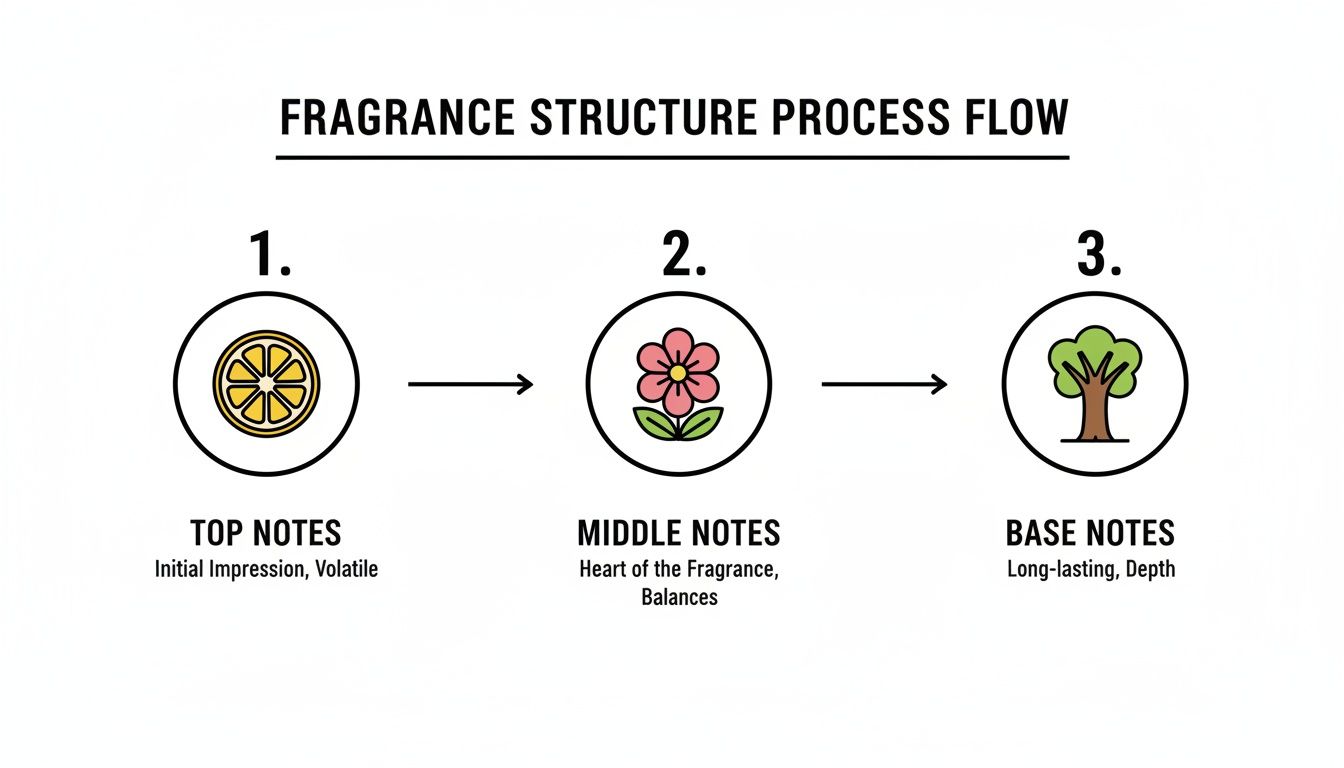
By applying the heaviest scents (those with prominent base notes) first, you create a solid foundation that allows the lighter middle and top notes to shine through without being overpowered.
Perfecting Your Scent Stacking Technique
This concept, often called 'scent stacking,' has become incredibly popular for a reason. One of my favorite methods is to start with a light fragrance mist all over, layer a more substantial EDP with strong mid-notes on pulse points, and then finish with just a dab of pure perfume oil for depth.
It's a huge trend, with 78% of fragrance lovers starting their layering journey with travel-sized options to experiment. And the data shows it works: layering complementary notes can extend a fragrance's wear time by a significant 4-6 hours.
Our collection of travel sprays at Fragrance Lord are perfect for getting the hang of these techniques. They offer an affordable way to experiment with rich, deep bases and vibrant top layers without committing to a full bottle. And for more foundational knowledge, be sure to check out our guide on how to use perfume for the best results.
Curated Scent Combinations You Can Try Today
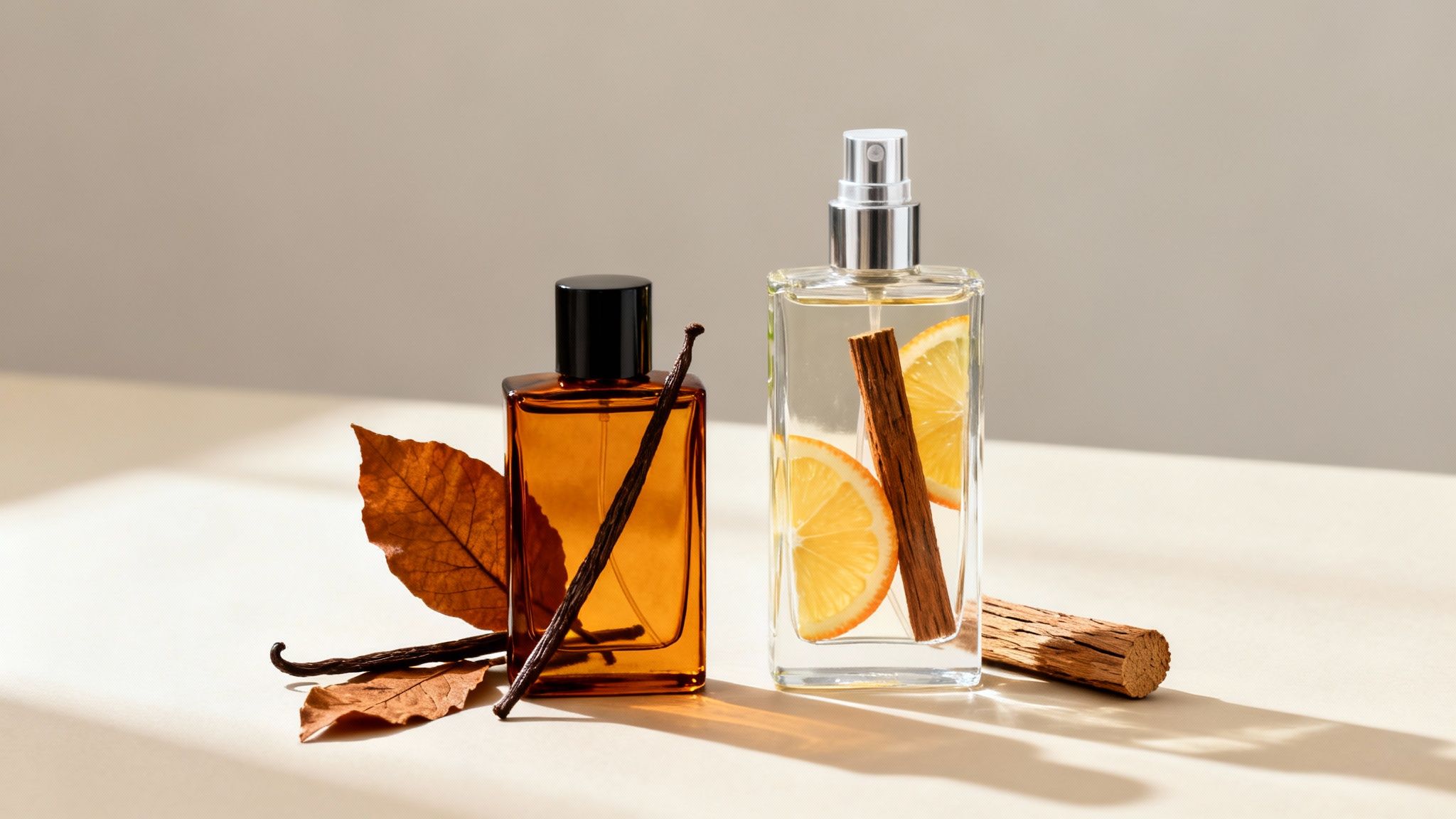
Alright, you’ve got the theory down. Now for the best part—actually playing with your scents and creating something that’s uniquely yours. If you're excited but a little unsure where to begin, I've put together a few combinations that are practically guaranteed to work.
These aren't just random pairings. Each one is built on the principles we've covered, from fragrance families to note pyramids, giving you a solid launchpad for your own experiments.
Safe Starters For Beginners
Dipping your toes into layering for the first time? The easiest and safest way to start is by pairing a more complex perfume with a simple, single-note scent. This trick lets you customize a fragrance you already love without worrying about a potential scent catastrophe.
Think of it as adding a pinch of salt to a dish—it just makes everything better.
A classic example I call The Warm Gourmand. Take a rich, cozy tobacco and vanilla fragrance like Parfums de Marly's Herod. Before you even spray it, massage a simple vanilla-scented body lotion into your pulse points. Not only does this moisturize your skin (which helps the perfume cling longer), but it also dials up Herod’s inherent sweetness, wrapping you in a delicious, warm scent cloud.
Another fantastic option is The Fresh Sophisticate. Start with a bright, clean fragrance—something like Maison Francis Kurkdjian's Aqua Universalis. Now, layer it over a light, green-tea-scented body mist. That touch of green adds a new dimension of crispness, making the whole vibe feel effortlessly modern and sharp.
Bold Pairings For The Adventurous
Feeling a bit more confident? Let's move on to mixing two distinct, multi-note fragrances. This is where the real magic happens, as you can craft a scent that’s entirely new and unexpected. The secret is finding a common thread—a shared note or a complementary family—to tie the two together.
One of my favorite pro tips is to bridge a bright citrus with a deep wood. The zesty, almost sharp quality of citrus has a way of cutting through the dense richness of woody notes, creating a stunningly balanced scent that evolves beautifully throughout the day.
For a real-world example, let's create The Citrus Woods Fusion. Start with a powerful, earthy base like Tom Ford's Oud Wood. After letting it settle for a moment, lightly mist a vibrant citrus, like Creed Aventus, over the same area. The energetic pineapple and bergamot in Aventus lift the heavy oud, transforming it into something both powerful and surprisingly refined. It’s a combination that truly makes a statement.
If that kind of dynamic pairing intrigues you, we've gone even deeper in our guide on how orange perfume blends with woods and florals.
Fragrance Layering Recipes From Fragrance Lord
To give you even more inspiration, I've put together a few of my favorite combinations using fragrances you can find right here in our store. Think of this as a recipe book to get you started on your scent-layering journey.
| Vibe | Base Fragrance (Heavier) | Top Fragrance (Lighter) | Resulting Scent Profile |
|---|---|---|---|
| Effortless Elegance | Maison Francis Kurkdjian - Baccarat Rouge 540 | Creed - Aventus For Her | A radiant, sophisticated blend where fruity brightness meets airy sweetness and warm amber. |
| Spicy & Sweet | Tom Ford - Tobacco Vanille | Kilian - Angels' Share | A decadent, boozy gourmand with amplified notes of cognac, cinnamon, and creamy vanilla. |
| Dark & Mysterious | Parfums de Marly - Layton | Initio Parfums Privés - Oud for Greatness | An incredibly rich and complex scent with deep spice, oud, and a hint of vanilla sweetness. |
| Clean & Uplifting | Xerjoff - Nio | Louis Vuitton - Imagination | A hyper-realistic citrus explosion grounded by soft florals and clean musk for ultimate freshness. |
Ultimately, the best combinations are the ones you discover yourself. This is why our travel sprays and discovery sets are so perfect for this kind of creative exploration. They let you experiment freely with all these authentic niche fragrances without having to commit to a full bottle right away. Happy mixing!
Common Layering Mistakes And How To Avoid Them
Getting into fragrance layering is a fantastic way to create your own signature scent, but let's be honest—it's easy to get it wrong. Even those of us with a whole shelf of bottles have created a few combinations that didn't quite hit the mark. Knowing the common pitfalls ahead of time is the secret to avoiding a confusing scent-puddle and crafting something truly special.
The most common slip-up? Simply going too heavy on the sprays. The art of layering is about adding dimension, not creating an overwhelming scent bomb that announces your arrival from a block away. Too much of a good thing just becomes... well, too much. The delicate notes get smothered, and you lose all the beautiful complexity. A good starting point is always one spray of each scent. You can always add more, but you can't take it away.
Clashing Notes And Overpowering Bases
Another classic mistake is forcing two fragrances together that just don't want to be friends. I'm all for experimentation, but some fragrance families are like oil and water. Trying to layer two incredibly heavy and complex oriental scents, for example, often ends up as a dense, muddy mess where you can't pick out the beauty of either one.
To get started on the right foot, try thinking in terms of balance. Here are a few simple guidelines I’ve learned over the years:
- DO pair a bright, zesty citrus with a deep, grounding wood.
- DON'T try to mix two intense, "statement" oriental fragrances.
- DO soften a warm amber with a light, simple floral.
- DON'T combine a sharp, grassy green scent with a creamy, sweet gourmand.
The order in which you apply your scents matters, too. Think about it in terms of weight and concentration. You'll want to spray the heaviest, most potent fragrance first so it doesn't completely mask the lighter one. For example, you might start with a rich parfum (20-30% oils), then add a more moderate EDP (15-20%), and finish with a light cologne (2-5% oils). Get it wrong, and you could find the sillage—the scent trail you leave behind—is cut by as much as 50%.
It's no wonder that 78% of fragrance lovers start their layering journey with minis before committing to full bottles. You can discover more insights about fragrance market trends and see just how popular this kind of experimentation has become.
The most overlooked mistake? Forgetting about your own skin chemistry. Your skin is the final ingredient, and it can completely change how a fragrance combination smells. What works beautifully on a paper strip might turn into something entirely different on you.
This is why testing is absolutely essential. Before you spray a new combo all over, try it on a small spot like your inner wrist. Give it a few hours. Let the top notes fade and see how the heart and base notes settle in and mingle on your skin.
This simple habit can save you from a lot of frustration (and money!). Exploring pairings with samples and travel sprays from Fragrance Lord is the smartest, most risk-free way to build your layering skills and find what truly works for you. And if you want to make sure your perfect creation sticks around, check out our guide on what makes a perfume last longer.
Your Fragrance Layering Questions Answered
As you start playing with different scents, you're bound to have questions. Everyone does. Nailing down the answers is how you'll go from simply mixing perfumes to truly creating a signature scent. Let's get into some of the most common questions I hear.
How Many Perfumes Can I Layer At Once?
I know it's tempting to create a symphony of scents, but when you're starting out, less is definitely more. Stick to just two fragrances. This gives their individual notes enough space to mingle and create something new and beautiful, rather than a confusing mess.
If you're feeling more adventurous, you can push it to three, but there's a trick to it. You'll want to use different formats. Think of it like this: start with a scented lotion as your base, add your main Eau de Parfum, and then maybe a light body mist on top. You're building complexity, not just piling on scent.
Can I Layer Fragrances From Different Brands?
Absolutely! In fact, you should. This is where the real creativity comes in. Forget the brand on the bottle for a second and focus on the notes inside. A deep, warm amber from Amouage could be the perfect foundation for a zesty, bright citrus from Creed.
This is the mindset shift from just wearing perfume to actually crafting a scent. When you start combining different houses, you're creating a fragrance that is uniquely, completely yours. Nobody else will have it.
This is a huge reason why our collection of samples and travel sprays at Fragrance Lord is so crucial. It's your playground for discovering those magical, unexpected pairings from brands you might not have committed to otherwise.
Should I Spray Layered Scents On My Clothes Or Skin?
Always, always start with your skin. Perfume truly comes alive when it mixes with your natural body heat; it’s what helps the fragrance notes open up and project. Your personal skin chemistry is that final, unlisted ingredient that makes any combination your own.
Hit your pulse points—the classics like your wrists, the sides of your neck, behind your ears, and even the crooks of your elbows. These spots are naturally warmer and will help diffuse the scent all day long. A light spritz on your scarf or jacket can help it last longer, but the real development and artistry of your layered scent happens right on your skin.
How Do I Test A New Fragrance Combination Before Committing?
This is a big one. The best way, without a doubt, is to use samples or travel sprays. Don't go all-in with a full wearing right away.
First, spray each scent on a different spot on your arm, maybe a few inches apart. This lets you see how each one behaves on its own with your chemistry. After a few minutes, go ahead and layer them on one wrist.
Now for the most important part: wait. Give it a few hours. Live with it. Perfumes change so much from the initial spray to the final dry-down. This little test drive lets you experience the entire story of your new creation before you decide to make it your scent of the day.
Ready to start your own scent experiments? The best fragrance layering tips always lead back to exploration. At Fragrance Lord, our extensive collection of discovery sets, travel sprays, and authentic niche perfumes gives you the perfect palette to play with. Find your next masterpiece at https://fragrancelord.com and begin crafting your unique signature today.